用 Opus 5.5 搭动态设计工作室(一):像素、环境与一句话片头
大多数人用 Opus 5.5 做动态设计,最后都落到同一条片子:渐变底上居中大字、全员淡入、片尾一个 logo。本篇从「模型写的是程序不是视频」讲起,装好工作室,再拆开那句走红的一句话 showreel prompt。
本篇属于系列 用 Opus 5.5 搭动态设计工作室 · 第 1 篇
原文:How to build motion design studio with Opus 5.5 (Full-course),作者 Movez(@0xMovez),以 X Article 形式发布。
本站是中英对照排版:左栏是英文原文,右栏是对应的中文译文。专有工具名与术语(seek(t)、Opus 5.5、Playwright、ffmpeg、Remotion、HyperFrames、Claude Code 等)在通顺处保留英文写法;原文配图全部保留。
本文是系列《用 Opus 5.5 搭动态设计工作室》的第 1 篇,共 4 篇。覆盖开篇至 03. One-liner。

Series cover: Opus 5.5 · /motion-graphic · FULL COURSE
How to build motion design studio with Opus 5.5 (Full-course)
用 Opus 5.5 搭动态设计工作室(完整课程)
Most people who try motion design with Opus 5.5 end up with the same video: centered text on a gradient, everything fading in, a logo at the end.
大多数人用 Opus 5.5 做动态设计,最后都落到同一条片子:渐变底上居中大字、全员淡入、片尾一个 logo。
They don’t give it a reference, don’t give it a render engine, don’t ask it to look at its own frames.
他们不给参考,不给渲染引擎,也不让它回看自己渲出来的帧。
This is the 12-step course that turns that mess into a repeatable studio pipeline. The prompt is 10% of the video. The other 90% is the harness.
这门 12 步课程,就是要把这团乱成可复用的工作室流水线。Prompt 只占片子的 10%,另外 90% 是 harness(整套驾驭系统)。
Follow my Substack to get fresh AI alpha: movez.substack.com
关注我的 Substack 拿最新 AI alpha:movez.substack.com
On September 22, 2026 Anthropic shipped Claude Opus 5.5.
2026 年 9 月 22 日,Anthropic 发布了 Claude Opus 5.5。
Within hours the timeline filled with showreels, launch videos, music videos and five-minute history films, all of them rendered from code.
几小时内时间线上就刷满了 showreel、发布片、MV 和五分钟历史片——全是从代码渲出来的。
Captions said “one prompt”. Replies said “motion designers are cooked”.
配文写「一句 prompt」。回复写「动态设计师完了」。
Both are half true. Some clips really came from a 30-word prompt.
两边都只对了一半。有些片子确实来自一句三十来词的 prompt。
Others came from a 9,500-character director’s brief, a folder of skills, two API keys and a 12-hour autonomous run.
另一些则来自 9500 字符的导演简报、一整夹 skills、两把 API key,外加 12 小时的自主跑。
Thariq from the Claude Code team summed up the gap in one line: the post says one-shot, the prompt is 10k characters with skills, examples, keys.
Claude Code 团队的 Thariq 一句话点破了落差:帖子写 one-shot,prompt 却是带 skills、示例和 key 的一万字符。
make a dynamic 15-second motion graphics video that shows what an
incredible motion designer you are, like it's your showreel for a résumé.
go all out.
This course shows you both ends and everything in between.
这门课会带你看清两端,以及中间的一切。
You’ll read every one of the 9 posts that defined the trend, copy the prompt pattern each one used, and then build the engine yourself.
你会读完定义这波趋势的 9 条帖子,抄下各自的 prompt 范式,然后自己把引擎搭出来。
A seek(t) renderer, closed-form springs, a beat grid, synthesized sound, and a critique loop that makes Opus fix its own frames.
一个 seek(t) 渲染器、闭式弹簧、节拍网格、合成配乐,以及逼 Opus 自己修帧的 critique loop。
Embedded X post: https://x.com/i/status/2102801469976248500
- Part 1 · What is actually happening
- 第 1 部分 · 到底在发生什么
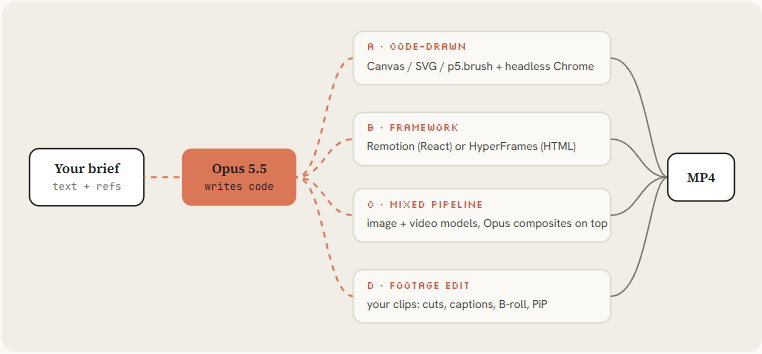
Figure: Your brief → Opus 5.5 writes code → four routes (A code-drawn / B framework / C mixed pipeline / D footage edit) → MP4
01. Pixels — model writes a program, not a video
01. Pixels —— 模型写的是程序,不是视频
Opus 5.5 takes text and images in and puts text out. It cannot emit an MP4. Every video in this trend is a program that Opus wrote, and something else turned that program into frames.
Opus 5.5 吃进去文本和图片,吐出来还是文本。它发不出 MP4。这波趋势里的每一条视频,都是 Opus 写的一段程序,再由别的东西把程序变成帧。
The core trick is determinism. Opus writes a single function, draw(t) or seek(t), that paints the exact frame for any moment in time.
核心手法是确定性。Opus 只写一个函数——draw(t) 或 seek(t)——给定任意时刻,就画出那一帧。
A headless browser calls it 900 times for 15 seconds at 60 fps, screenshots each frame, and ffmpeg stitches them.
无头浏览器在 15 秒、60 fps 下调用它 900 次,每帧截图,再由 ffmpeg 拼起来。
Nothing depends on a timer, so the render is identical every run and a change is a one-line edit plus a re-render.
什么都不依赖定时器,所以每次渲染结果一致;改一处就是一行编辑再重渲。
Tommy Rossi dug into the one-shot output and found Opus prefers route A with zero dependencies: one index.html, a seek function called through eval, Playwright capturing frame by frame, ffmpeg encoding.
Tommy Rossi 拆过 one-shot 产物,发现 Opus 默认走零依赖的路线 A:一个 index.html、经 eval 调用的 seek 函数、Playwright 逐帧截屏、ffmpeg 编码。
Make a dynamic 20-second motion graphics video for [PRODUCT] ([URL]), with the energy
of a motion designer's showreel. Go all out.

Assets
- Visit the site. Use real screenshots (Playwright), the real logo, real colors and fonts.
  Save everything to ./assets and list what you found before you animate.
- Never redraw the product UI from imagination. Crop and animate the real thing.

Story (one beat each, 2 to 4 seconds)
1. Hook: the problem in 5 words of huge kinetic type.
2. The product appears, the UI assembles itself piece by piece.
3. Three features, each as a UI moment with a cursor doing a real action.
4. One number that proves it works: [METRIC].
5. Logo lockup + [CTA].

Sound
- Original music, 120 BPM, synthesized in code. UI clicks and whooshes on the beat.

Format: 1080x1920 (9:16) first, then 1:1 and 16:9 from the same timeline.
Before the full render, show me a contact sheet of one frame per beat.
It skipped Remotion and HyperFrames even when available. If you want a framework, say so explicitly.
即便 Remotion、HyperFrames 已经装好,它也会跳过。想走框架,就得明确说。
02. Setup — install the studio in 10 minutes
02. Setup —— 十分钟装好工作室
The chat app can write an animation, but only Claude Code (or any agent with a shell) can render it, listen to it and look at its own frames.
聊天应用能写出动画,但只有 Claude Code(或任何带 shell 的 agent)能把它渲出来、听一遍、再回看自己的帧。
That feedback loop is the whole difference between the “mid” first try people complain about and the viral ones.
这条反馈环,就是大家吐槽的「有点 mid」初稿和那些爆款之间的全部差别。
Then drop a house-rules file in the project root. Claude Code reads CLAUDE.md on every run, so these rules apply to every video you make here without repeating them.
然后在项目根目录丢一份家规。Claude Code 每次运行都会读 CLAUDE.md,这些规则就会自动套到你在这里做的每一条片子上,不用反复说。
# 1. Runtime: Node 22+, ffmpeg, Python for audio analysis
brew install node ffmpeg python          # macOS; apt install on Linux
pip install numpy librosa soundfile

# 2. A clean project and a headless browser
mkdir motion-studio && cd motion-studio && npm init -y
npm i -D playwright && npx playwright install chromium

# 3. Framework skills (optional, route B)
npx skills add remotion-dev/skills       # /remotion-create, /remotion-render ...
npx skills add heygen-com/hyperframes    # /hyperframes router + GSAP skills

# 4. Hand-drawn look (optional): Node canvas rigs, pens, synthesized sound
claude plugin marketplace add buildwithhanif/claude-animation-skill
claude plugin install claude-animation@claude-animation-skill

# 5. Start Claude Code on Opus 5.5 at high effort
claude --model claude-opus-5-5
> /model   # pick Opus 5.5, then set effort to xhigh for one-shots, max for flagship pieces
Opus 5.5 defaults to medium effort and always thinks before answering. Every viral one-shot in the list ran on xhigh or max.
Opus 5.5 默认 medium effort,而且答之前总会先想。列表里每一条走红的 one-shot,跑的都是 xhigh 或 max。
Use medium for small fixes and re-renders, xhigh for new films, max when the first 3 seconds have to carry a launch.
小修小补和重渲用 medium;新片子用 xhigh;前 3 秒必须撑住一场发布时用 max。
Embedded X post: https://x.com/i/status/2103875898349088830
- Part 2 · Prompting like a director
- 第 2 部分 · 像导演一样写 prompt
03. One-liner — showreel prompt and why it works
03. One-liner —— showreel 那句话,以及它为什么管用
Four of the nine posts used the same sentence. It’s worth understanding why a single line produced 15 seconds of camera moves, kinetic type and audio.
九条帖里有四条用了同一句。值得搞清:为什么一行字就能换来 15 秒镜头运动、动能文字和声音。
- “showreel for a résumé” sets a genre with known rules: fast cuts, a new technique every shot, the best work first. Opus already knows what a reel looks like.
- “what an incredible motion designer you are” makes the model the subject, so it shows techniques instead of explaining a product. No content to get wrong.
- “15-second” is short enough to finish in one pass and long enough for 6 to 8 shots.
- “go all out” works as an effort multiplier on top of xhigh or max.
- 「showreel for a résumé」定下有成规的体裁:快剪、每镜一种新手法、最好的先上。Opus 本来就知道 reel 长什么样。
- 「what an incredible motion designer you are」让模型自己当主角,于是它展示手法而不是讲解产品——没有会讲错的内容。
- 「15-second」短到能一遍做完,又长到够塞 6 到 8 个镜头。
- 「go all out」叠在 xhigh / max 之上,相当于努力乘数。
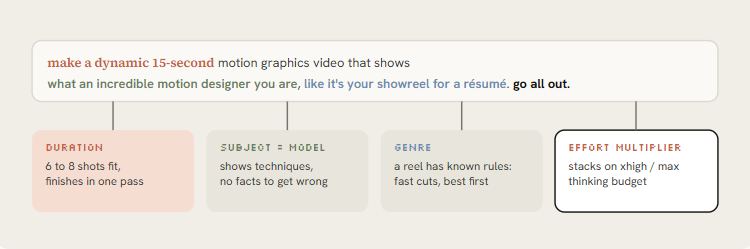
Figure: Anatomy of the one-liner showreel prompt — duration, subject = model, genre, effort multiplier
The original 15-second résumé reel on Max effort. The source of the prompt. Put it directly under the anatomy diagram.
Max effort 上那条原始 15 秒简历 reel——这句 prompt 的源头。直接放在解剖图下面。
Same prompt on xhigh, one-shot including audio. Shows xhigh is enough, and that the sound was not added in post.
同一句 prompt 跑在 xhigh 上,one-shot 连音频都有。说明 xhigh 够用,声音也不是后期另加的。
Embedded X post: https://x.com/i/status/2102681172367323300
The weakness: the athemeroy dataset calls it “brief contagion”. Hundreds of identical prompts produced reels that rhyme with each other. Use it to test your setup, then move on. Variants that shipped and worked:
弱点:athemeroy 数据集管这叫「brief contagion」(简报传染)。几百条一模一样的 prompt,渲出的 reel 彼此押着韵。用它测通你的环境,然后往前走。下面是已经上线、确实管用的变体:
# Longer, with a sound bar (pattern from @kloss_xyz's 90-second piano reel)
make a dynamic 16:9, 60-second motion graphics showreel that shows your real creative limits.
S-tier sound design, no generic synth pads. Compose an original piano score and sync every
cut to it. Export 1080p MP4.

# Anti-slop guardrail (pattern from @1littlecoder)
make a dynamic 10-second motion graphics video that introduces who you are as Opus 5.5.
Avoid frames and text in the corners, the usual giveaways of AI-made video.

# Story instead of techniques (pattern from @sonnylazuardi)
use your showreel energy, but tell a story: the history of [TOPIC] from [START] to today,
surprise me with the storyboard. 45 seconds, vertical 9:16.

# Agency persona
make a 30-second showreel as if you were a niche branding studio for startup founders.
Create every graphic from scratch. One accent color. Every shot is a different technique.
A one-liner tests the engine. It never tests the idea, because it doesn’t contain one.
一句话测的是引擎。它测不了点子——因为它根本不含点子。
→ 下一篇:(二)品牌、参考与状态清单
→ 下一篇:(二)品牌、参考与状态清单
讨论
这里是静态站点,没有内嵌评论区。如果这篇文章对你有用,欢迎通过 RSS 订阅后续更新。